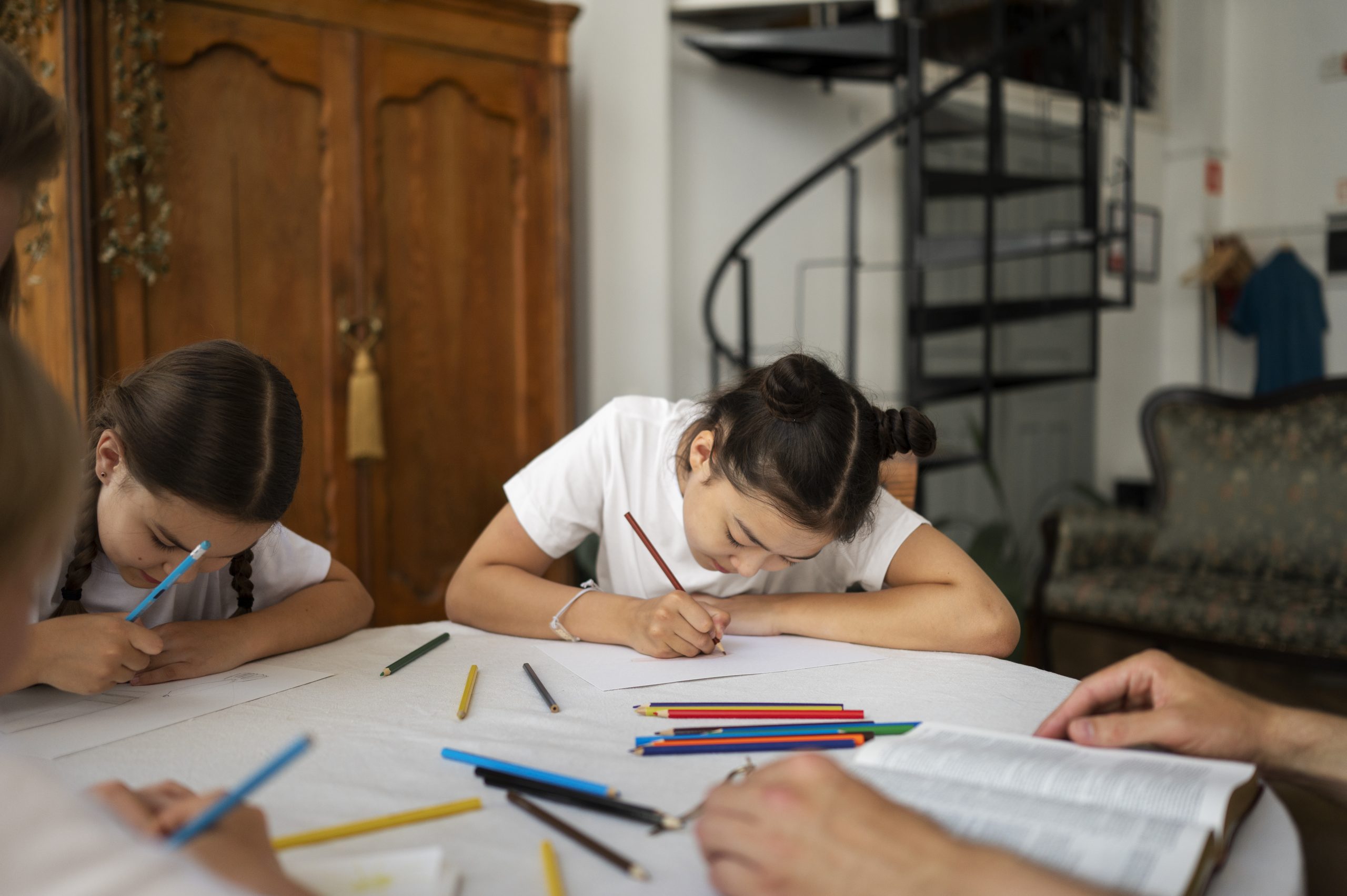
For most Singapore parents, the simplest answer is this: start with Math Olympiad first, then add Science Olympiad once your child is confident with competition-style problem solving. Math Olympiad has more entry points from lower primary, builds the logical reasoning that science contests also rely on, and gives your child an earlier runway toward the Primary 5 competitions that matter most for Direct School Admission. Science Olympiad works best once a child has the reading stamina and conceptual maturity to handle applied, experiment-based questions. Here is how to decide what is right for your child in 2026.
What Is the Difference Between Math Olympiad and Science Olympiad Training in Singapore?
Math Olympiad training develops non-routine problem solving – number patterns, logic, combinatorics and spatial reasoning that go well beyond the school syllabus. Science Olympiad training is broader and more applied: it tests scientific concepts, experimental reasoning and the ability to apply knowledge to unfamiliar, real-world scenarios across biology, chemistry and physics.
The biggest practical difference is the starting point. Quality olympiad math tuition can begin as early as Primary 1 or 2 because the skills are largely self-contained. Science Olympiad training assumes a base of scientific knowledge and stronger reading comprehension, so it usually starts later – typically from Primary 4.
The Competitions Compared: NMOS, APMOPS, RMO vs SPSO, SJSO, RSO
On the maths side, the headline primary competitions are NMOS (National Mathematical Olympiad of Singapore, for Primary 5, organised by NUS High School), APMOPS (Asia-Pacific Mathematical Olympiad for Primary Schools, run by Hwa Chong for Primary 6, with Primary 5 entry now allowed) and Raffles Mathematical Olympiad (RMO), organized by Raffles Institution. RMO comprises two categories – Junior Category for Primary 4-5 and Open Category for Primary 6. Entry-level contests such as SASMO and SMKC start even earlier.
On the science side, SPSO (Singapore Primary Science Olympiad) is for Primary 5, also organised by NUS High; RSO (Raffles Science Olympiad) is hosted by Raffles Institution; and SJSO (Singapore Junior Science Olympiad) extends the pathway into secondary school, covering biology, chemistry and physics. If you want a deeper look at the maths track, see our guide to the Singapore Mathematical Olympiad.
Which Requires Earlier Training: Math or Science?
Math, almost always. The reasoning skills Olympiad Maths develops – pattern recognition, logical deduction and structured problem solving – take months, sometimes years, to mature. Because contests exist from lower primary, an early start compounds: a child who begins training in Primary 2 or 3 arrives at the high-stakes Primary 5 competitions already fluent in the format.
Science Olympiad rewards a later start. A child needs enough scientific vocabulary, reading stamina and conceptual grounding to interpret experiment-based questions, so starting too early often breeds frustration rather than progress. For most families the sequence is clear: build the Maths foundation first, then introduce Science Olympiad training once that base is in place.
Signs Your Child Is Naturally Drawn Toward Math Olympiad
Enjoys puzzles, brain teasers and number games for fun – not just homework
Looks for shortcuts or patterns instead of grinding through repetitive steps
Stays curious about a hard problem rather than giving up quickly
Picks up new Maths concepts fast and asks why they work
Finds normal school Maths too easy or repetitive
If several of these sound familiar, your child is likely to thrive in Olympiad math tuition – and the earlier they start, the more naturally these thinking habits form.
Signs Your Child Is Better Suited for Science Olympiad Training
Asks how things work – gadgets, nature, the human body, the weather
Loves hands-on experiments and learning by doing
Reads widely and has strong comprehension
Connects classroom science to the real world
Remembers facts easily and enjoys explaining them to others
A child like this often flourishes in Science Olympiad training Singapore programmes, where applied reasoning and experimental thinking matter as much as raw recall. Strong reading ability is the common thread – it is what lets them decode multi-step science questions under time pressure.
Can Your Child Do Both? How to Plan a Dual Olympiad Journey
Yes – and many high-achievers do, which is why a strong portfolio across both subjects is so valuable for Direct School Admission. The key is sequencing, not stacking everything at once.
A realistic plan: build the maths foundation in lower primary, introduce Science Olympiad training around Primary 4, then run both in parallel through the crucial Primary 4-6 year, when RMO, NMOS, SPSO and the APMOPS lead-up all converge. Watch your child’s workload and energy – a dual journey should stretch them, not exhaust them. A combined programme that coordinates both subjects under one roof makes this far easier to manage.
How Global Education’s Combined Maths and Science Olympiad Programme Covers Both
Global Education’s Maths & Science Olympiad programme is built for exactly this dual pathway. It prepares primary students for the major Maths contests – RMO, NMOS, APMOPS, SASMO and more – and the key science competitions, including SPSO, with the same small-group attention.
Every child starts with an assessment that maps proficiency and goals, followed by a tailored plan, customised materials, past-year competition papers and regular mock contests so progress is measurable. With a track record of medal-winning students and dedicated DSA support, the programme helps families turn Olympiad results into real secondary-school opportunities. To find out whether maths, science or both is the right starting point for your child, book a trial class.
Conclusion
For the majority of Singapore children, the smart sequence is Math Olympiad first, Science Olympiad second – both built on the same foundation of curiosity and structured reasoning. But the right answer always depends on your individual child: their interests, their reading maturity, and how much runway you have before the Primary 5 competition crunch.
Start with the subject that genuinely excites your child, begin earlier rather than later, and choose a programme that can grow with them across both disciplines. Do that, and the Olympiad journey becomes less about chasing medals and more about building a confident thinker who is ready for whatever comes next.
Frequently Asked Questions
What age should my child start Math Olympiad in Singapore?
Most children can begin from Primary 1 or 2, when entry-level contests like SASMO, SMKC are pitched to challenge without overwhelming. Primary 5 is the most important primary year, since key competitions such as NMOS are restricted to that level – so starting two to three years earlier gives your child time to master the format.
Is Science Olympiad harder than Math Olympiad?
Not harder, just different. Science Olympiad demands stronger reading comprehension and a base of scientific knowledge, which is why it usually starts later. Math Olympiad is more self-contained and can begin earlier. Many children find maths the easier entry point and science the more natural next step.
Do Math and Science Olympiad results help with DSA?
Yes. Schools such as Raffles, Hwa Chong and Nanyang value strong olympiad track records, and results in competitions like RMO, NMOS, and APMOPS can support Direct School Admission applications. A consistent portfolio across both subjects is more persuasive than a single medal.
Can my child train for both Math and Science Olympiad at the same time?
Yes, with careful sequencing. Build the maths foundation first, add science from around Primary 4, then run both in parallel during Primary 5. A combined programme that coordinates both subjects helps your child progress without burning out.
If you have been following education news in Singapore, you have likely heard about the changes coming to gifted education. Announced by Prime Minister Lawrence Wong during the National Day Rally in August 2024, Singapore’s new approach to supporting high-ability students represents the most significant change to gifted education in four decades. In simple terms, it is MOE’s replacement for the Gifted Education Programme (GEP). It is designed to identify and develop high-ability students across Singapore’s primary schools – but with a fundamentally different philosophy from the GEP model it replaces.
Where the GEP selected the top 1% of students through a high-stakes two-stage test and transferred them to nine designated schools, the new approach takes a broader, more inclusive stance. It aims to develop high-ability learners within their own schools while offering optional advanced enrichment modules at 15 designated centres. The programme takes full effect from 2027, but the transition is already underway – making 2026 a pivotal year for parents with children in the P2 to P4 range.
Why Singapore Is Moving Away from the GEP
The GEP has been a cornerstone of Singapore’s education system since 1984. For 40 years, it identified the top 1% of each P3 cohort and placed them in a specialised curriculum at one of nine designated schools. It produced generations of high achievers, and the programme carried enormous prestige.
So why retire it? MOE’s rationale centres on several key concerns that have grown over the decades.
First, the single high-stakes screening created intense pressure on very young children – and their families. The GEP label became as much about status as about education, driving a cottage industry of preparation that often worked against the programme’s original intent.
Second, research in gifted education has evolved. International studies increasingly show that high ability is not a fixed trait identifiable in a single test at age nine. It develops over time, and different children peak at different stages. A one-shot assessment at P3 inevitably misses late bloomers and disadvantages children whose abilities do not align neatly with the test format.
Third, limiting the programme to nine schools meant uprooting children from their neighbourhood schools, disrupting friendships and community ties. MOE recognised that the social cost of school transfers was not always justified by the educational benefit.
The new approach addresses all three concerns: broader identification, multiple entry points, and no school transfer required.
How the New Programme Works
Singapore’s refreshed approach to high-ability education operates on a two-tier structure that is genuinely different from anything tried before in gifted education here.
Tier 1 – School-based provisions. All primary schools in Singapore will implement in-class strategies to stretch high-ability learners. This includes differentiated activities, enrichment tasks within the regular curriculum, and teacher training to identify and nurture advanced thinking. About 10% of each cohort will have access to these school-based high-ability programmes, up from around 7% today. This tier ensures that high-ability students benefit from enhanced learning regardless of whether they are selected for Tier 2.
Tier 2 – Advanced modules at designated centres. Students identified through the process described below are offered optional weekly sessions at one of 15 designated centres across Singapore. These are two-hour subject-specific sessions in English, Maths, or Science, held after school hours during term time. During school holidays, interdisciplinary modules are offered – combining elements across subjects around a central theme or challenge.
The 15 host schools are: Ahmad Ibrahim Primary, Clementi Primary, Geylang Methodist School, Innova Primary, Jurong West Primary, Kheng Cheng School, Palm View Primary, Pioneer Primary, Punggol View Primary, Queenstown Primary, St Gabriel’s Primary, Tampines Primary, Teck Ghee Primary, Yew Tee Primary, and Yu Neng Primary School. They were selected to ensure a good geographic spread and are accessible via public transport.
Classes are taught by specially trained teachers experienced in working with high-ability students in specific domains. Importantly, these teachers are not drawn from the staff of the primary school hosting the centre – they are separately deployed by MOE.
Crucially, students remain at their own schools. There is no transfer. They attend the enrichment modules on top of their regular schooling, keeping their classmates, their teachers, and their community intact.
Another important feature is flexibility. Participation is not compulsory, and students can exit and re-enter the programme based on their needs and development. Schools are also encouraged to nominate students who are strong in multiple areas for only one subject per semester, to ensure a balanced workload.
How HAL Students Are Identified – The New One-Stage Process
This is the section parents are most curious about, so let us be specific.
Under the old GEP model, identification was a two-stage process: a broad P3 Screening Exercise, followed by a Selection Test for shortlisted students. The full GEP process assessed students across English, mathematics, and science. Under the new approach, this is replaced by a single-stage identification exercise.
The first identification exercise is scheduled for August 2026 for the current P3 cohort. The exercise assesses aptitude in English and Maths – importantly, it tests thinking ability rather than mastery of the school syllabus. This means a student who is advanced in English reasoning but average in Maths, for example, could still qualify for a high-ability English programme at their school.
School-based evidence supplements the test results. Using guidelines and checklists provided by MOE, schools will observe factors such as a student’s attitude towards learning and overall potential. This holistic approach is designed to capture high-ability learners who may not perform optimally in a timed test setting but demonstrate exceptional thinking and curiosity in everyday classroom contexts.
Identification is also no longer a one-time event. In subsequent years, schools will be able to nominate suitable Primary 4 and Primary 5 students for both the school-based programmes and the advanced modules. This multi-point approach reflects current research on how high ability emerges at different rates in different children.
One further indicator of the programme’s broader ambition: MOE expects the advanced modules to be open to at least double the current GEP cohort, given that students only need to demonstrate strength in a specific subject area rather than performing well across all domains.
What This Means for Parents with High-Ability Children in 2026
If you are a parent with a child in P2 or P3 right now, here is what you should be thinking about.
Assess readiness honestly. Does your child demonstrate genuine higher-order thinking – curiosity, reasoning, making connections – or are they simply performing well on standard schoolwork? The programme is designed for children whose abilities go beyond syllabus mastery.
Start preparation early, but wisely. The skills the identification exercise tests – inferential comprehension, verbal reasoning, and non-routine problem solving – take time to develop. P2 Term 3 remains a sensible starting point for structured enrichment. But preparation should focus on building thinking, not drilling test papers.
Understand that the game has changed. The new approach rewards genuine ability demonstrated across multiple contexts, not single-test performance. MOE has been explicit that the advanced modules are not intended to give students a leg up in examinations – they are designed to cultivate curiosity, creativity, and critical thinking. This means quality preparation matters more than ever, because the skills need to be real, not performative.
Choose tuition that aligns with the new model. Programmes that focus purely on test preparation for a specific screening date may need to evolve. The best programmes – like those at Global Education Hub – have always focused on developing higher-order thinking rather than gaming a test. Under the new model, that approach is more aligned than ever.
At Global Education Hub, our GEP English and GEP Maths programmes have been developing higher-order thinkers for over 17 years. As the transition to the new system unfolds, our approach remains the same: build the thinking skills that genuinely set high-ability children apart. Whether the assessment is called GEP or something new, the skills that matter have not changed – and neither has our commitment to developing them.
Conclusion
Singapore’s new approach to high-ability education is not just a rebrand of the GEP. It is a genuine rethinking of how the country identifies and nurtures its most capable young learners – broader in scope, more flexible in timing, less dependent on a single high-pressure test, and more accessible to students with specific rather than universal strengths.
For parents, the transition means letting go of some familiar reference points while embracing a model that is, in many ways, fairer and more developmentally sound. The skills your child needs – critical thinking in English, mathematical reasoning, intellectual curiosity – remain the same. What has changed is how those skills are assessed, where they are developed, and how many children get the opportunity to benefit.
The children who will thrive under the new programme are the same ones who would have thrived under the GEP: genuine thinkers, not just test takers. And the best thing parents can do in 2026 is ensure their child has the opportunity to develop those thinking skills – early, consistently, and with the right guidance which is with Global Education Hub.
Frequently Asked Questions About the HAL Programme
Is the GEP still running in 2026?
The GEP is in its final transition phase. The last cohort of GEP students was admitted in 2024 and will complete the programme in 2028. From 2027, the new approach fully replaces the GEP. In 2026, the first identification exercise will take place in August for P3 students, making this a transitional year.
Does my child need to change schools?
No. Unlike the GEP, the new programme does not require students to transfer to a designated school. Students remain at their current school and attend optional advanced modules at one of 15 centres after school hours. The nine former GEP schools will cease to be GEP centres.
How is the new identification different from the old GEP screening?
The GEP used a two-stage process – a broad screening followed by a selection test – assessing students across English, mathematics, and science. The new system uses a single-stage identification exercise in English and Maths aptitude, complemented by school-based observations of a student’s attitude towards learning and potential, using MOE-provided guidelines and checklists.
Can my child be identified at P4 or P5 if they miss the P3 exercise?
Yes. This is one of the most significant changes from the GEP model. In subsequent years, schools will be able to nominate suitable P4 and P5 students for both the school-based programmes and the advanced modules. Missing the P3 exercise does not close the door.
Should I still enrol my child in GEP tuition for 2026?
Yes, because the underlying skills being assessed have not changed – inferential comprehension, verbal reasoning, and non-routine problem solving are still central. Quality GEP tuition that focuses on developing these thinking skills remains directly relevant to the new identification exercise. What matters is choosing a programme that builds genuine ability rather than test-specific tricks.
What subjects are covered in the advanced modules?
The programme offers advanced modules in English, Maths, and Science. Weekly two-hour sessions are held during term time at designated centres, and interdisciplinary holiday modules combine elements across subjects. The content is not linked to the national curriculum – it is designed to stretch thinking, not to accelerate students through the school syllabus.
Does my child need to be strong in all subjects to qualify?
No – this is a key change from the GEP. A student who is strong in English but average in Maths, for example, can still be accepted into a high-ability English programme. The new approach identifies domain-specific strengths rather than requiring across-the-board performance.
Are the modules compulsory?
No. Participation is optional, given that students may have other commitments or interests. Students can also exit and re-enter the programme based on their needs and development.
Every parent in Singapore has had that moment. Your child comes home with a test paper, and the score is lower than expected. You ask what happened, and the answer is a shrug or a quiet “I don’t know.” The question is – when does a bad result become a pattern, and when does a pattern become a problem that needs outside help?
Singapore’s primary school classrooms are effective, but they have structural limitations. Class sizes of 30 to 40 students mean teachers cannot give every child individual feedback on every piece of work. The curriculum moves at a fixed pace, and students who need a little more time on a topic get left behind – not because teachers don’t care, but because the schedule doesn’t allow it.
Self-study at home helps, but only up to a point. Many parents find that their child can complete homework but struggles with exam-style questions, or understands a concept when explained but cannot apply it independently. These are signs that something deeper is going on – and they are worth paying attention to before PSLE pressure makes everything harder.
Signs Your Child Is Struggling with Primary English
English is one of those subjects where struggles can hide in plain sight. A child might be reading books regularly and speaking fluently, yet still underperform on paper. Here are the warning signs to watch for:
They avoid written work or rush through compositions with minimal detail. Their essays are short, repetitive, and lack descriptive language. They score well on grammar worksheets but make inconsistent errors in continuous writing. Comprehension answers are vague or incomplete – they can find information in a passage but struggle to infer meaning from it. Oral confidence is low, with hesitation during read-aloud or conversation segments.
For students approaching P6, these gaps become critical. English tuition for primary 6 students is not about learning grammar rules from scratch – it is about building the exam technique, vocabulary depth, and writing stamina that the PSLE English paper demands. A child who cannot write a structured, engaging composition under timed conditions by P6 is at a significant disadvantage.
The earlier these signs are addressed, the less pressure the child faces at the PSLE stage. English skills compound over time – a student who builds strong sentence construction at P3 or P4 carries that skill through every year that follows.
Signs Your Child Needs Primary Science Tuition
Science is the subject that surprises parents the most. A child who “understands everything” at home can still lose marks consistently on school papers. The reason is almost always the same: they know the concept but cannot express it the way the examiner expects.
Open-ended questions (OEQs) are where most marks are lost. Students write answers that are technically correct but miss the keywords that examiners are looking for. They struggle to structure answers using the Concept-Link-Reasoning framework that Singapore’s Science curriculum demands. Process skills like identifying variables, forming hypotheses, and interpreting data tables become increasingly important from P4 onwards – and many students simply have not been trained to approach them systematically.
At P5, the syllabus introduces new topics – the human reproductive system, the water cycle in greater depth, electrical circuits – that require a higher level of scientific reasoning. Science tuition for primary 5 students helps bridge this gap by teaching not just content, but the answering techniques that convert understanding into marks.
By P6, PSLE Science tuition becomes about exam readiness: timed practice, exposure to tricky question formats, and building the confidence to tackle unfamiliar scenarios without freezing. Primary 6 science tuition should focus on consolidation and application, not learning new content from scratch — which is why starting earlier matters so much.
Signs Your Child Needs Primary Maths Tuition
Maths is often the first subject where parents notice a problem, because the grades are hard to argue with. But the warning signs usually appear before the grades drop:
Your child gives up on problem sums without attempting them. They make consistent “careless” errors that are actually conceptual misunderstandings – confusing area with perimeter, or misapplying a ratio. They perform well in class tests but fall apart under exam conditions when questions are mixed across topics. They avoid Paper 2 entirely or leave multiple questions blank.
These patterns are especially common at P5 and P6, when the PSLE Maths syllabus introduces multi-step problem sums that require students to combine concepts from different topics. A child who has memorised formulas but not understood the logic behind them will struggle here.
P6 maths tuition and structured PSLE maths tuition centre programmes work best when they go beyond content delivery. The right programme diagnoses exactly where the student’s understanding breaks down – is it the concept itself, the application to word problems, or the time management under exam pressure? – and targets that specific gap.
What Happens When You Wait Too Long to Enrol
This is the conversation no parent wants to have in September of the P6 year: “We should have started earlier.”
Knowledge gaps in primary school do not stay static. They compound. A student who does not fully understand fractions at P4 will struggle with ratios at P5, which means percentage and speed problems at P6 become nearly impossible. A student who never learns to structure Science OEQ answers at P4 will keep losing the same marks at P5 and P6 – they are not making new mistakes, they are repeating old ones.
The PSLE timeline is unforgiving. P5 is when the most demanding new content is introduced. P6 is when students are expected to consolidate, revise, and perform under national exam conditions. There is no buffer year. Parents who enrol their child in tuition at P6 are essentially asking a tutor to fill gaps, teach exam technique, and manage exam anxiety – all within ten months.
Early intervention – starting at P3 or P4 – gives students the time to build genuine understanding rather than surface-level memorisation. It turns the PSLE year into a refinement phase rather than a rescue mission.
What a Good Primary Tuition Programme Does Differently
Not all tuition is the same, and at the primary level, the difference between effective tuition and expensive babysitting comes down to a few key practices:
Diagnostic assessment on enrolment. Before any teaching begins, the centre should identify exactly where the student’s gaps are – by topic, by skill, and by question type. This prevents wasted time reteaching content the student already knows.
Targeted gap-filling. Rather than following the school syllabus week by week, effective tuition prioritises the topics and skills where the student loses the most marks. This is especially important for PSLE maths tuition centre programmes, where a targeted approach can recover more marks in less time.
Exam technique training. Content knowledge is only half the battle. Students need to know how to manage time, eliminate answer options, structure open-ended responses, and check their work systematically. These are trainable skills – but most schools do not teach them explicitly.
Structured parent updates. Parents should receive regular, specific feedback – not just “doing well” or “needs improvement,” but clear reporting on which topics have been covered, where the student has improved, and what the next focus area is.
Recognising the Signs Early Makes All the Difference
If you have noticed any of the signs discussed in this article – declining grades, avoidance behaviours, strong understanding but weak exam performance – the time to act is now, not next term.
The right tuition programme will not just help your child pass exams. It will teach them how to learn effectively, build their confidence in tackling difficult questions, and give them the structured support that a classroom of 35 students simply cannot provide.
Whether your child needs English tuition for primary 6 preparation, primary 6 science tuition to lock in PSLE readiness, or p6 maths tuition to master problem sums – starting with a proper diagnostic and a clear plan makes all the difference.
At Global Education Hub, our primary tuition programmes are designed around exactly this approach: diagnose first, then target gaps systematically with experienced MOE teachers who understand the PSLE inside and out. Book a trial class to see how we can help your child build the skills and confidence they need.
Conclusion
The signs that a child needs tuition are rarely dramatic. They show up quietly – in a reluctance to start homework, in marks that slip by a few points each term, in the gap between what a child knows and what they can demonstrate on paper. The key is recognising these signals early enough to act before they become entrenched.
Primary school in Singapore moves fast. The PSLE does not wait for students to catch up. Whether the need is in English, Science, or Maths, the most effective intervention is the one that starts before the problem becomes a crisis – and that addresses the root cause, not just the symptoms.
Frequently Asked Questions
When should I start tuition for my primary school child?
The ideal time to start is P3 or P4, when the curriculum begins to increase in difficulty and gaps first appear. Starting early gives your child time to build genuine understanding rather than relying on last-minute cramming before PSLE. However, if your child is already at P5 or P6, targeted tuition that focuses on specific weak areas can still make a meaningful difference.
How do I know if my child needs English tuition or just more reading?
Reading helps with vocabulary and general comprehension, but it does not teach exam technique – how to structure a composition, how to answer inferential comprehension questions, or how to perform in oral exams. If your child reads regularly but still scores poorly on English papers, the issue is likely skill application, not exposure. English tuition for primary 6 students specifically targets these exam-ready skills.
Is PSLE Science tuition worth it if my child already scores well?
Yes, if there is room to move from a B to an A or from AL4 to AL1. PSLE science tuition focuses on eliminating the small but consistent mark losses that separate good students from top scorers – keyword accuracy in OEQs, process skill application, and handling unfamiliar question scenarios. Even strong students benefit from structured exam practice.
What makes a good PSLE maths tuition centre?
Look for centres that start with a diagnostic assessment, focus on understanding rather than memorisation, provide regular mock exams under timed conditions, and give parents specific progress updates. A good PSLE maths tuition centre will also train problem-solving strategies – not just formulas – so students can tackle unfamiliar multi-step questions.
Can tuition help if my child has exam anxiety?
Absolutely. Much of exam anxiety stems from uncertainty – not knowing what to expect or how to manage time. Regular exposure to exam-format papers, timed practice, and structured review of mistakes builds familiarity and confidence. Over time, exams start to feel like a routine rather than an event.
Should I get a private tutor or send my child to a tuition centre?
For primary school students, a tuition centre with small class sizes (8-15 students) often works better than private tutoring. Centres offer structured curricula, peer learning, and access to curated materials and mock papers that most private tutors cannot match. The group environment also helps children build confidence by learning alongside peers at a similar level.
Ask any parent in Singapore when schoolwork “gets real,” and the answer is almost always the same – Secondary 1. The jump from primary school to secondary school is not just a change of uniform. It is a complete reset in how students learn, how they are assessed, and how much independence they are expected to show overnight.
At Primary 6, students deal with four core subjects. By Sec 1, that number can double. Maths splits into topics like algebra and geometry. Science is no longer a single paper – it becomes an integrated blend of Physics, Chemistry and Biology. English shifts from simple comprehension passages to formal essay writing and critical analysis. And all of this happens while 12-year-olds are still adjusting to a new school, new friends, and a new daily routine.
Here is what many families underestimate: gaps that form at Sec 1 and Sec 2 do not stay small. They compound. A student who struggles with Sec 1 Math foundations in algebra will hit a wall when Additional Mathematics appears at Sec 3. A student who never builds proper sentence structure at Sec 1 will find O-Level argumentative essays almost impossible by Sec 4. The MOE streaming system – where students are placed into Express, Normal Academic, or Normal Technical tracks – adds further pressure, because subject combinations at Sec 3 depend directly on Sec 2 results.
This is precisely why Secondary Maths tuition, English support, and Science intervention matter far more at this stage than at primary level. The stakes are higher, the content is harder, and the runway to the O-Levels is shorter than most families realise.
Secondary Maths Tuition: Building From Sec 1 Foundations to O-Level Mastery
Mathematics at the secondary level in Singapore is a four-year marathon, not a sprint. What students learn at Sec 1 directly shapes how they perform at Sec 4 – and the curriculum is designed that way on purpose.
At Sec 1, students encounter formal algebra, geometry, and basic statistics for the first time. These are not just new topics; they require a completely different way of thinking compared to primary school arithmetic. Math Sec 1 is where students must learn to work with variables, manipulate equations, and apply logical reasoning – skills that many find genuinely difficult without guidance.
By Sec 2, the content deepens. Sec 2 Math introduces simultaneous equations, Pythagoras’ theorem, and more advanced data analysis. Students who coasted through Sec 1 on memory alone often struggle here, because Sec 2 demands genuine understanding rather than rote recall.
The real turning point arrives at Sec 3, when the curriculum splits into Elementary Mathematics (E-Maths) and Additional Mathematics (A-Maths). A-Maths – covering trigonometric identities, differentiation, and integration – is a subject that catches many students off guard. Without strong algebra foundations built at Sec 1 and Sec 2, students find themselves trying to learn new concepts while simultaneously patching old gaps. That is a losing battle.
Structured secondary Maths tuition addresses this by ensuring each level is properly consolidated before the next one begins. Good tuition does not just reteach what the school covered that week. It identifies where the student’s understanding broke down – whether that was last month or last year – and repairs it systematically.
Secondary English Tuition: From Comprehension Basics to O-Level Confidence
English at the secondary level is one of those subjects that parents tend to deprioritise – until it is too late. The assumption is that because students have been learning English since kindergarten, they should be fine. But O-Level English is a different animal entirely, and the skills it demands are built across all four years.
At Sec 1 and Sec 2, the focus is on foundational writing skills – narrative and descriptive essays, basic comprehension techniques, and structured grammar. Secondary 1 English tuition is critical here because it sets the standard for how students approach written expression. A student who learns to plan essays properly at Sec 1 carries that discipline all the way to the O-Levels. A student who does not will spend Sec 3 and Sec 4 trying to unlearn bad habits under exam pressure.
From Sec 3 onwards, the demands increase sharply. Students must handle argumentative and discursive essays, situational writing (formal letters, reports, proposals), summary writing, and oral communication. The O-Level English paper tests not just language ability, but critical thinking – the ability to construct a logical argument, evaluate a passage, and communicate ideas clearly under timed conditions.
Where students typically fall behind without structured support is in the transition from creative writing at lower secondary to analytical writing at upper secondary. Many students can tell a story well but struggle to build an argument. Tuition bridges that gap by teaching frameworks for essay structure, exposing students to model answers, and building vocabulary in context rather than through word lists.
Secondary Science Tuition: Navigating Integrated Science and the Sec 3 Split
Science at the lower secondary level in Singapore is taught as an integrated subject – meaning students study Physics, Chemistry, and Biology concepts within a single paper. For many students, this is the first time they encounter formal scientific methodology, and the breadth of content can be overwhelming.
Sec 1 Science tuition helps students build a working understanding across all three disciplines simultaneously. Topics range from cells and body systems (Biology) to acids and bases (Chemistry) to forces and energy (Physics). The challenge is not that any single topic is impossibly hard – it is that students must juggle multiple scientific frameworks at once, each with its own vocabulary and logic.
Lower secondary science tuition is particularly valuable because it prevents students from mentally “giving up” on one discipline early. A student who decides at Sec 1 that Chemistry is too confusing will carry that anxiety into Sec 3, where the subject becomes a standalone paper with far more demanding content. Early intervention keeps all three doors open.
The Sec 3 transition is where the real pressure hits. Students choose between pure and combined Science options, and the jump in difficulty – especially for pure Physics and pure Chemistry – is significant. Students who had solid lower secondary foundations adapt more quickly. Those who did not often find themselves in a cycle of falling behind, cramming for tests, and falling behind again.
Secondary Biology Tuition: From Integrated Science to O-Level Mastery
Biology begins as part of the integrated Science syllabus at Sec 1 and Sec 2, where students learn about cells, organ systems, and basic ecology. At this stage, the content is manageable – but it is also deceptively easy to skim through without truly understanding it.
The problem surfaces at Sec 3 and Sec 4, when students take on full O-Level Biology. Topics like Genetics, DNA replication, enzyme function, Transport in Plants, and Ecology demand a level of detail and precision that catches many students off guard. Secondary biology tuition helps students build the kind of deep, structured understanding that the O-Level examiners are looking for – not just knowing what happens, but explaining why and how.
One of the biggest challenges in Biology is the free-response format. Unlike multiple-choice questions, structured and essay questions require students to articulate scientific processes clearly and completely. Many students understand a concept intuitively but lose marks because they cannot express it with the right keywords and logical flow.
Biology tuition O-level preparation should start well before Sec 4 – ideally at the point where students transition from integrated Science into the pure Biology syllabus. Building strong answering techniques and content retention from Sec 3 onwards makes the O-Level year about refinement rather than panic.
Secondary Chemistry Tuition: Bridging the Gap From Sec 1 to O-Level
Chemistry is, for many Singapore students, the subject that goes from “manageable” to “overwhelming” almost overnight. At Sec 1 and Sec 2, Chemistry topics within the integrated Science syllabus — acids and bases, elements and compounds, separation techniques – feel relatively straightforward. Students can often get by with surface-level understanding.
Then Sec 3 arrives. Suddenly, students are dealing with the mole concept, stoichiometry, chemical bonding, and the beginnings of organic chemistry. Secondary 3 Chemistry tuition is so commonly sought after precisely because this is the point where most students first feel genuinely lost. The mole concept alone requires a combination of mathematical reasoning and chemical understanding that many students have never had to apply before.
Secondary Chemistry tuition that works does not start at the point of crisis. The best approach builds a progressive understanding from Sec 1 basics – particulate theory, chemical reactions, periodic table trends – through to Sec 3 and Sec 4 application questions. When students understand why atoms bond the way they do (Sec 1-2 foundations), they find stoichiometry and organic chemistry far more intuitive at Sec 3-4.
By Sec 4, O-Level Chemistry requires students to tackle qualitative analysis, electrochemistry, and extended application questions that test conceptual depth. Students who had early, structured support are better equipped to handle these demands without last-minute cramming.
The Benefit of Choosing One Tuition Centre for All Secondary Subjects
Many families in Singapore end up with a patchwork of tuition arrangements – one centre for Maths, a private tutor for English, a different group class for Science. On paper, each arrangement might be fine individually. In practice, this fragmented approach creates problems that are easy to overlook.
When a student attends a single tuition centre for all their secondary subjects, the benefits compound. Teachers share visibility into the student’s overall academic profile. If a student is struggling in Chemistry, for instance, a Maths teacher at the same centre might notice that the root cause is weak algebraic manipulation – a cross-subject insight that separate providers would never catch.
There are practical advantages too. Scheduling becomes simpler. Families deal with one point of contact instead of three or four. The cumulative cost is often lower than paying multiple providers separately. And perhaps most importantly, students benefit from a consistent teaching philosophy – the same expectations around homework, revision, and accountability across every subject.
Centres that follow a student from Sec 1 through to O-Level also eliminate transition friction. The teacher already knows the student’s strengths, weaknesses, and learning habits. There is no wasted time “starting over” with a new tutor every year.
When Is the Right Time to Start Secondary Tuition?
The honest answer is: earlier than most parents think. The two most critical enrolment windows for secondary tuition in Singapore are Sec 1 Term 1 and Sec 3 Term 1.
Sec 1 Term 1 matters because it is when the transition shock from primary school is at its peak. Students are adjusting to new subjects, new teachers, and a faster pace of learning. Early support – especially in Sec 1 Math, English, and Sec 1 Science tuition – prevents small gaps from becoming entrenched weaknesses.
Sec 3 Term 1 is the second critical window, particularly for students taking pure Sciences or A-Maths for the first time. The difficulty jump is steep, and students who wait until mid-year to seek help often find themselves too far behind to catch up comfortably before the O-Level year.
The cost of waiting is always higher than the cost of starting early. A student who begins tuition at Sec 1 builds habits, fills gaps, and develops confidence progressively. A student who starts at Sec 4 is essentially asking a tutor to compress four years of learning into ten months – while simultaneously preparing for national exams.
What to Look for in a Secondary Tuition Centre in Singapore
Not all tuition centres are created equal, and at the secondary level, the differences matter more than at primary. Here is what parents should evaluate before committing:
Teacher qualifications and experience. Are the teachers former MOE educators? Do they have subject-specific expertise at the O-Level standard? A great primary school tutor does not automatically make a great secondary school tutor – the content demands are fundamentally different.
O-Level track record. Ask for results. A centre that consistently produces A1 and A2 grades across multiple subjects has proven its methodology works.
Class size. Small group classes (8-15 students) strike the right balance between affordability and individual attention. Anything larger than 20 starts to resemble a school classroom, which defeats the purpose.
Mock papers and exam practice. Regular exposure to exam-format questions — especially from Sec 3 onwards – is non-negotiable for O-Level readiness.
Parent communication. Look for centres that provide regular progress updates, not just end-of-term report cards. Parents should know what their child is working on, where they are improving, and what still needs attention.
Trial class availability. Any reputable centre should offer a trial lesson so students and parents can assess fit before committing financially.
How Global Education Hub Supports Secondary Students Across All Five Subjects
At Global Education Hub, secondary tuition is not a side offering – it is a core part of what we do. Our programmes cover Maths, English, Science, Biology, and Chemistry from Sec 1 through to O-Level, with experienced MOE teachers and Heads of Department leading every class.
What sets us apart is continuity. The same teaching team follows students across levels, so there is no lost context when a student moves from Sec 2 to Sec 3, or transitions from integrated Science into pure Chemistry or Biology. Our teachers know each student’s academic profile – their strengths, their blind spots, and their learning pace – and they adjust accordingly.
We offer structured programmes for secondary maths tuition (both E-Maths and A-Maths), secondary English tuition with a focus on O-Level writing and comprehension skills, lower secondary science tuition that builds a strong foundation across all three disciplines, and dedicated secondary biology tuition and secondary chemistry tuition tracks for students taking pure Sciences at Sec 3 and Sec 4.
If your child is entering Sec 1 and you want to set them up with the right support from day one – or if they are already at Sec 3 and need targeted help before the O-Levels – we invite you to book a trial class and see the difference that structured, multi-subject tuition can make.
Conclusion
Secondary school in Singapore is not the time to take a wait-and-see approach. The curriculum moves fast, the stakes are high, and the gap between students who get structured support and those who do not widens with every passing term.
Whether your child needs help with Sec 1 Math foundations, Sec 1 English tuition to build writing confidence, Science tuition to stay on top of integrated Science, or specialised Biology tuition and Chemistry tuition preparation at Sec 3 and Sec 4 – the key is to start early, stay consistent, and choose a centre that can support them across subjects and levels.
The right tuition partner does not just help students pass exams. It helps them genuinely understand what they are learning – and carry that understanding forward into every year that follows.
Frequently Asked Questions About Secondary Tuition in Singapore
What subjects should my child get tuition for at Sec 1?
The three most impactful subjects to support at Sec 1 are Maths, English, and Science. Sec 1 Math and Sec 1 Science tuition help students adjust to the significantly harder curriculum, while Sec 1 English tuition builds the formal writing and comprehension skills that the O-Level paper demands later on.
Is it too late to start tuition at Sec 3?
It is not too late, but it is more challenging. Sec 3 is when subjects like A-Maths, pure Chemistry, and pure Biology ramp up in difficulty. Students who start tuition at Sec 3 need intensive support to cover both current content and any gaps carried over from Sec 1 and Sec 2. Starting at Sec 1 is always the better option, but Sec 3 Term 1 is the latest effective entry point.
How is secondary maths tuition different from primary maths tuition?
Primary Maths focuses largely on arithmetic, problem sums, and model drawing. Secondary Maths tuition shifts to abstract reasoning – algebra, geometry proofs, trigonometry, and eventually calculus in A-Maths. The thinking skills required are fundamentally different, which is why Sec 2 Math and beyond demand a tuition approach that prioritises understanding over memorisation.
What is the difference between combined and pure Science at Sec 3?
Combined Science covers two disciplines (usually Physics and Chemistry) in a single paper, while pure Science treats each discipline as a separate, full-syllabus subject. Pure Sciences go deeper into each topic and are required for many JC Science stream combinations. Lower secondary science tuition helps students build the breadth needed to qualify for pure Sciences at the Sec 3 subject selection.
How many hours of tuition per week does a secondary student need?
For most students, one to two sessions per subject per week – each lasting 1.5 to 2 hours – is sufficient. The key is consistency rather than volume. A student who attends tuition regularly from Sec 1 will need less intensive support at Sec 4 compared to a student who starts late and tries to cram.
Should I choose a tuition centre or a private tutor for secondary subjects?
Both can work, but a tuition centre offers advantages that private tutors typically cannot – structured curricula, mock exam access, peer learning, and cross-subject visibility. For secondary students juggling multiple subjects, a centre that handles all of them under one roof is usually more effective and easier to manage.
How do I know if my child’s tuition centre is actually helping?
Look for measurable improvement over a term – not just in grades, but in the student’s confidence and ability to attempt questions independently. Good centres provide regular progress updates and are transparent about where the student still needs work. If after two terms there is no observable change, it may be time to reassess.
Singapore’s Gifted Education Programme represents one of the most competitive academic pathways, with only the top 1%, between 400 to 500 students, selected annually. As we approach the final year of the current GEP format, with screening on 21 August 2025 and selection on 14-15 October 2025, stakes have never been higher. The rigorous two-stage process demands exceptional performance in both English and Mathematics, making specialised GEP tuition essential. About 1 in 10 students proceed to the second round, requiring abilities far beyond grade level. Professional gep tuition provides the strategic preparation needed for Singapore’s most elite academic programme.
Mastering GEP English
Advanced reading comprehension skills beyond primary school level
The English component demands sophisticated language skills well beyond Primary 3 expectations. Parents report the English level is pitched at Secondary School standard, requiring students to navigate complex passages with critical thinking abilities typically developed years later.
Critical thinking and analytical abilities for complex texts
Most comprehension questions revolve around inference from short text pieces, demanding sophisticated deduction skills beyond surface-level understanding. Students must extract deeper meanings while demonstrating analytical prowess that distinguishes gifted learners.
Creative writing techniques for gifted-level expression
Gep english preparation requires students to articulate complex ideas with precision and flair. This component challenges students to demonstrate creative writing abilities showcasing intellectual maturity and sophisticated communication skills.
Vocabulary expansion for sophisticated communication
Students must possess extensive vocabulary and strong inference skills for demanding language assessments. The vocabulary component extends far beyond standard Primary 3 expectations, requiring broad exposure to sophisticated terminology.
Inference and interpretation skills for challenging passages
The most challenging aspect involves developing advanced inference and interpretation abilities. Students must demonstrate sophisticated reasoning skills while analysing complex textual materials under examination conditions.
Time management strategies for English components
With limited time and multiple passages, students must develop efficient reading strategies. Effective english tuition for primary 6 level skills becomes crucial for Primary 3 students demonstrating language proficiency of much older learners.
Excelling in GEP Maths
Problem-solving techniques for non-routine mathematical challenges
The Mathematics component requires problem-solving techniques extending far beyond standard curriculum. The Math paper resembles Math Olympiad questions, emphasising elevated mathematical thinking required for this demanding assessment.
Logical reasoning and pattern recognition skills
Figure and number pattern questions follow specific rules and challenge even Primary 6 students, highlighting advanced mathematical concepts that students must master. These skills form the foundation of GEP Maths success.
Advanced mathematical concepts beyond standard curriculum
Students must demonstrate sophisticated mathematical understanding through strategic thinking for complex multi-step problems. Higher-order thinking skills mean rote learning proves insufficient for success.
Mathematical communication and explanation abilities
Clear articulation of problem-solving approaches becomes crucial as students must explain their mathematical reasoning. This tests both computational skills and mathematical communication effectiveness.
Strategic thinking for complex multi-step problems
Students face complex mathematical challenges requiring genuine understanding and creativity. Strategic problem approach and multi-step thinking distinguish successful candidates.
Precision and accuracy under examination conditions
Maintaining accuracy while managing time across 20-25 multiple-choice and 20-25 open-ended questions requires exceptional focus and mathematical precision.
Why Professional GEP Tuition Makes the Difference
Specialised curriculum designed for gifted-level challenges
Professional gep tuition provides specialised curriculum specifically created for gifted-level challenges, offering detailed topical notes and practice questions addressing unique GEP assessment demands.
Expert instructors familiar with GEP examination formats
Instructors familiar with GEP formats bring invaluable experience, understanding specific requirements and expectations of these demanding assessments.
Targeted practice with past-year questions and similar formats
Intensive practice with past-year questions in exam-simulated environments develops familiarity with unique question types while building essential time management skills.
Individual attention to strengthen weak areas
Personalised support addresses each student’s specific needs, ensuring weak areas receive focused attention while building on existing strengths.
Confidence building through progressive skill development
Progressive skill development helps students approach challenging assessments with proper mental preparation, building confidence necessary for optimal performance.
Structured preparation timeline for optimal results
Clear roadmap for GEP preparation ensures adequate time for skill development, providing families with systematic preparation strategies maximising success potential.
Choosing the Right GEP Preparation Programme
What to look for in quality English GEP tuition providers
Quality English GEP tuition providers should demonstrate deep understanding of sophisticated language skills required for success. Look for programmes that teach students to identify contextual clues from Comprehension and Cloze passages while developing inference and deduction skills with effective answering techniques.
Essential features of effective Maths GEP coaching
Effective Maths coaching must include exposure to complex problem-solving methodologies and advanced mathematical concepts. Comprehensive coverage of essential and difficult modules in GEP Math ensures students develop the sophisticated mathematical thinking required for success.
Benefits of comprehensive preparation covering both subjects
The GEP requires high aptitude in both Mathematics and English, making integrated preparation programmes particularly valuable. Comprehensive dual-subject preparation addresses demanding requirements for both assessment areas.
How to evaluate tuition centre credentials and track records
Consider programmes led by experienced educators with proven GEP success rates. Look for instruction from award-winning coaches and GEP graduates from top universities.
Investment in your child’s gifted education journey
Investment in comprehensive preparation requires careful consideration of programme quality, instructor expertise, and curriculum design addressing all GEP preparation aspects.
Conclusion
As Singapore’s Gifted Education Programme undergoes its final selection exercise in its current format, 2025 represents a unique opportunity for Primary 3 students. The demanding requirements for excellence in both GEP English and GEP Maths make professional preparation essential. The competitive selection process, with only 1 per cent selected, demands strategic preparation addressing sophisticated skills. From advanced English tuition for primary 6 level comprehension to complex mathematical problem-solving, students must demonstrate competencies well beyond grade level. Professional GEP tuition provides specialised curriculum, expert instruction, and targeted practice necessary for success. As families prepare for this final opportunity, comprehensive preparation becomes essential for Singapore’s most competitive academic programme.
The transition from primary to secondary mathematics marks a critical juncture in every Singapore student’s academic journey. Singapore consistently ranks among the world’s top performers in mathematics, with 15-year-olds scoring 575 points compared to the OECD average of 472 points. This excellence requires building solid foundations during the crucial lower secondary years. Lower secondary years bridge elementary arithmetic with advanced analytical thinking required for upper secondary levels. Without proper foundation building during Sec 1 math and Sec 2 math, students often struggle significantly when facing O-Level challenges, making early intervention through quality Sec math tuition essential for long-term success.
Sec 1 vs Sec 2 Math Progression
The mathematical journey from Secondary 1 to Secondary 2 represents a significant escalation in complexity and abstract thinking.
Sec 1 Math Foundation:
Basic algebraic expressions and equation solving
Fundamental geometric concepts, including angles and triangles
Introduction to statistical data interpretation
Sec 2 Math Advancement:
Advanced algebraic manipulation and complex equations
Geometric proofs and coordinate geometry
Probability concepts and statistical analysis
Multi-step problem-solving integration
In lower secondary math, students learn to simplify expressions, solve linear equations, and apply algebraic principles to real-life scenarios. The progression from Math Sec 1 to Secondary 2 shows increasing complexity where students apply concepts in real-world contexts.
The integration of multiple mathematical concepts in a single question becomes prevalent in sec 2 math, requiring sophisticated problem-solving strategies. This progression prepares students for streaming decisions impacting their upper secondary mathematics pathways according to Singapore’s Ministry of Education curriculum guidelines.
Essential Skills for Lower Secondary Maths Success
Mastering lower secondary mathematics requires developing five core competencies:
Algebraic Manipulation and Equation Solving:
Understanding variables and constants
Solving linear equations systematically
Simplifying complex expressions confidently
Geometric Reasoning and Proof Construction:
Visualising spatial relationships
Understanding angle properties and relationships
Constructing logical geometric arguments
Data Interpretation and Statistical Analysis:
Reading and creating various graph types
Calculating measures of central tendency
Understanding probability concepts
Problem-Solving Strategies for Multi-Step Questions:
Breaking complex problems into manageable steps
Identifying relevant information and relationships
Verifying solutions for reasonableness
Time Management During Examinations:
Allocating appropriate time per question based on marks
Strategic question prioritisation
Systematic checking procedures
Common Pitfalls and Solutions
Understanding why students struggle with lower secondary mathematics helps identify effective intervention strategies.
Primary Learning Gap Issues:
Many students enter sec 1 math with unresolved primary-level weaknesses. Teachers have to keep revisiting certain topics for students who lack foundational knowledge.
Abstract Thinking Challenges:
Primary school maths focuses on recognising concepts and applying formulas. Secondary school maths is taught in topics instead, as outlined by Singapore’s Ministry of Education. This shift from concrete to abstract thinking creates adjustment difficulties.
Consistent practice with graduated difficulty levels
How Targeted Tuition Addresses Individual Weaknesses:
Quality sec math tuition provides personalised attention that mainstream classroom environments often cannot offer. In Singapore’s competitive academic landscape, where households spent S$1.8 billion on tuition in 2023, math tuition provides the edge needed to thrive.
Preparing for Upper Secondary Maths Challenges
Success in lower secondary mathematics directly impacts upper secondary performance and O-Level outcomes.
Essential Skills and Knowledge for Sec 3 Success:
Solid algebraic manipulation for advanced equation solving
Strong geometric reasoning for trigonometry concepts
Confident statistical analysis for data interpretation
Systematic problem-solving approaches for complex scenarios
Building Mathematical Confidence and Resilience:
Students who master Math Sec 1 and Sec 2 math fundamentals develop confidence necessary to tackle Additional Mathematics and advanced topics. This psychological foundation proves crucial when facing challenging O-Level examination conditions.
Creating Strong Foundations for O-Level Excellence:
Algebra is central to Secondary 1 Mathematics, forming the foundation for Calculus and future topics such as trigonometry. Early mastery prevents future academic struggles and opens doors to science and mathematics-related career pathways, as demonstrated by Singapore’s mathematics education research.
Strategic Planning for Math Success
Parents play a crucial role in ensuring their children thrive in lower secondary mathematics through strategic planning and support.
Actionable Steps for Mathematical Excellence:
Early Assessment and Intervention
Identify learning gaps before they compound through regular assessments and targeted sec math tuition when necessary.
Consistent Practice Routine
Establish daily mathematics practice sessions focusing on concept understanding rather than memorisation.
Progress Monitoring
Track improvement through regular testing and adjust learning strategies based on performance data.
Professional Support Selection
Choose qualified tutors or learning centres with proven track records in lower secondary mathematics education.
Communication with Schools
Maintain regular contact with teachers to understand classroom progress and areas needing additional support.
Conclusion
Building a strong foundation in lower secondary mathematics requires strategic planning, consistent effort, and often professional guidance through quality secondary math tuition. The progression from sec 1 math to sec 2 math represents preparation for lifelong analytical thinking and problem-solving capabilities.
Success in math sec 1 and sec 2 math isn’t just about immediate grades – it’s about developing mathematical literacy necessary for success in our increasingly quantitative world. Parents who invest in solid mathematical foundations during lower secondary years give their children tools for academic excellence and future career success in STEM fields.
By understanding the challenges, implementing effective strategies, and seeking appropriate support when needed, every student can build the mathematical confidence and competence necessary for upper secondary success and beyond. For families seeking comprehensive mathematics support, quality tuition programs like the ones offered by Global Education Hub can provide the personalised guidance needed to excel in Singapore’s demanding academic environment.
Singapore’s education landscape has become increasingly competitive, with parents seeking every possible advantage for their children’s academic future. The Direct School Admission (DSA) scheme offers a golden pathway to prestigious secondary schools, and achievements in maths and science olympiads have emerged as powerful differentiators in this competitive arena. Unlike traditional academic results, olympiad competitions demonstrate exceptional problem-solving abilities, analytical thinking, and subject mastery that top schools actively seek.
Students who excel in math olympiad tuition and science olympiad Singapore competitions consistently secure coveted spots at elite institutions. These achievements showcase intellectual curiosity and academic excellence that extend far beyond classroom performance, making Olympiad participants desirable candidates for DSA programs across Singapore’s most sought-after schools.
DSA Requirements and Olympiad Advantages
Top secondary schools evaluate DSA applications through multiple lenses, seeking students who demonstrate exceptional talent, leadership potential, and academic passion. Schools like Raffles Institution, Hwa Chong Institution, and Nanyang Girls’ High School particularly value students with strong Olympiad track records, as these competitions align perfectly with their academic excellence standards.
5 evidence of a student’s potential. The Singapore Primary Science Olympiad and various mathematics competitions serve as standardised benchmarks that admissions committees can easily evaluate and compare across candidates. Successful DSA applicants often present portfolios featuring multiple Olympiad achievements, demonstrating sustained excellence across both Maths Science Olympiad and individual subject competitions. These accomplishments signal to schools that students possess the intellectual rigour necessary for advanced academic programs and specialised curricula.
Strategic Competition Selection
Not all olympiad competitions carry equal weight in DSA applications. The Singapore Mathematical Olympiad (SMO), RIPMWC, and Singapore Primary Science Olympiad rank among the most prestigious and recognised competitions by top schools. Parents should strategically plan their children’s competition journey, focusing on quality over quantity.
Math olympiad development requires a curiosity-driven approach that goes beyond drill practice. The optimal timing involves starting foundational training in Primary 3-4, with serious math olympiad tuition Singapore programs beginning by Primary 5 to allow sufficient preparation time for major competitions.
Building a comprehensive maths and science olympiad portfolio requires careful planning across multiple years. Students should aim for consistent participation in 2-3 major competitions annually, focusing on achieving medals or certificates of distinction rather than attempting too many competitions with mediocre results.
Training Investment vs DSA Returns
The financial investment in quality math olympiad tuition represents exceptional value when compared to potential returns. Parents investing S$3,000-5,000 annually in specialised olympiad training often secure DSA placement at schools with fees exceeding S$20,000 per year, creating substantial long-term savings.
The significance and benefits of mathematics olympiad training extend far beyond immediate competition results. Students develop advanced problem-solving skills, mathematical reasoning abilities, and analytical thinking that benefit them throughout their academic careers.
Beyond immediate DSA advantages, science olympiad Singapore achievements often lead to scholarship opportunities and enhanced university admission prospects. The intellectual foundation built through intensive olympiad training creates lasting academic advantages that compound over time.
School-Specific Strategies
Different prestigious schools emphasise varying aspects of Olympiad achievement in their DSA evaluation processes. Raffles Institution particularly values students with strong mathematical reasoning demonstrated through competitions like SMO, while schools like Singapore Chinese Girls’ School may place additional emphasis on science olympiad Singapore performance.
Understanding how to develop mathematical passion through olympiad participation helps parents align their children’s preparation with specific school preferences. Some institutions prefer students with broad maths and science olympiad exposure, while others favour deep specialisation in single subjects.
Research each target school’s DSA criteria carefully, noting which competitions they specifically mention or value. This intelligence allows parents to optimise their math olympiad tuition Singapore investments toward competitions that carry maximum weight with their preferred institutions.
Implementation Roadmap
Parents should begin DSA planning by Primary 4, allowing sufficient time for comprehensive Olympiad preparation. Start with foundational math olympiad tuition to assess your child’s natural aptitude and interest level before committing to intensive training programs.
Science olympiad preparation develops next-generation problem-solving skills essential for future academic success. Establish consistent training schedules that balance Olympiad preparation with regular school requirements, ensuring your child maintains strong overall academic performance.
The impact of Olympiad results on educational opportunities extends throughout students’ academic journeys. Create a structured timeline that includes competition registration deadlines, intensive training periods, and DSA application submissions to maximise success probability.
Monitor your child’s progress regularly and adjust strategies based on performance and interest levels. Some students excel in Singapore primary science olympiad competitions while others demonstrate stronger mathematical aptitudes, allowing parents to focus resources where children show greatest potential.
Conclusion
Maths and science olympiad achievements provide unparalleled advantages in Singapore’s competitive DSA landscape. Students who invest in quality science and math olympiad tuition Singapore programs and strategic competition participation consistently outperform peers in securing placement at prestigious secondary schools.
The combination of intellectual development, academic recognition, and DSA advantages makes olympiad training one of the most valuable investments parents can make in their children’s educational futures. With proper planning, strategic competition selection, and quality training support at Global Education Hub, students can leverage maths science olympiad achievements to unlock doors to Singapore’s most elite educational institutions.
Success in olympiad competitions requires dedication, strategic planning, and expert guidance. Parents considering this pathway should begin early, choose training programs carefully, and maintain a long-term perspective on the substantial returns that olympiad excellence delivers throughout their children’s academic careers.
Singapore has earned the reputation as the world’s “tuition nation,” with the private tutoring industry valued at $1.4 billion annually. This substantial investment reflects parents’ unwavering commitment to academic excellence in one of the world’s most competitive education systems. Despite Singapore’s world-class public education system consistently ranking among the top globally, approximately 70% of students attend tuition. This phenomenon doesn’t reflect educational inadequacy but rather highlights the strategic gap between standard curriculum delivery and the heightened demands of competitive academic success.
In Singapore’s merit-based society, parents understand that school excellence alone may not provide the comprehensive preparation needed for competitive advantage in an increasingly globalised economy. With grade inflation across PSLE, O-Levels, and A-Levels, achieving “good” results no longer guarantees access to premier institutions. Tuition centres bridge this gap by providing specialised attention and advanced preparation that enables students to exceed elevated expectations.
The Academic Reality: Why School Alone Isn’t Enough
Singapore’s Competitive Academic Landscape
Singapore’s education system operates within an intensely competitive framework where academic performance directly determines future pathways. The numbers tell a compelling story: only 8% of students gain admission to top-tier junior colleges, while university acceptance rates remain around 27% of each cohort.
The PSLE Achievement Level scoring system reflects this heightened competition. Similarly, O-Level and A-Level results show consistent yearly improvements, making it increasingly challenging for students to distinguish themselves academically.
School System Limitations
Singapore’s schools maintain exceptionally high educational standards and deliver world-class instruction. However, structural realities create natural gaps that tuition centres are uniquely positioned to address.
Most classrooms accommodate 30+ students, making individualised attention inherently challenging. Even the most dedicated teachers cannot provide the customised support that different learning paces require. Additionally, fixed curriculum schedules often leave limited time for in-depth exploration of advanced concepts or additional practice for struggling students. These aren’t failings of the system but natural constraints of large-scale education delivery.
The Tuition Advantage
Tuition centres excel precisely where large-scale education faces inherent limitations. Through smaller class sizes of 4-12 students, instructors can immediately identify and address individual learning gaps. This personalised approach allows flexible pacing that matches each student’s abilities and learning style.
The additional practice hours outside school prove crucial for concept mastery. Expert guidance from specialised subject teachers provides insights that enhance school learning, while intimate group environments foster deeper understanding through meaningful peer interaction.
Primary School Success: Building Strong Foundations
Early Primary Support (P1-P3)
The foundational early primary years set the trajectory for future academic success. Tuition centres during this critical period focus on establishing proper study habits and learning techniques while reinforcing school concepts for deeper understanding.
Early identification and addressing of learning gaps prevents minor difficulties from evolving into significant challenges later. The systematic approach to developing fundamental skills, combined with structured practice beyond school homework, builds learning resilience and confidence that proves invaluable throughout a student’s academic journey.
Upper Primary Excellence (P4-P6)
The upper primary years mark a critical transition where PSLE preparation becomes paramount. The stakes are undeniably high, as PSLE scores directly determine secondary school options and set the foundation for future academic pathways.
Tuition centres provide intensive support that addresses complex problem-solving techniques, effective time management strategies, and crucial exam stress management. English tuition for primary 6 students becomes particularly vital, as language proficiency directly impacts performance across all PSLE subjects, requiring mastery of composition writing, comprehension skills, and grammar application under exam conditions.
Comprehensive subject preparation includes exposure to challenging questions beyond standard textbooks, developing the higher-order thinking skills essential for secondary school academic rigour. This preparation creates competitive advantages for preferred school placement while building the strong foundations necessary for continued success.
GEP Success: Nurturing Gifted Minds
The Gifted Education Programme (GEP) represents Singapore’s most selective academic pathway, with only the top 1% of students selected annually through rigorous screening processes. These assessments require advanced skills that significantly exceed mainstream curriculum expectations, demanding specialised preparation that regular classroom settings cannot adequately provide.
Why GEP Tuition Centres Are Essential
GEP-focused tuition centres provide expert training specifically designed for screening and selection test requirements. GEP English preparation develops advanced comprehension skills, sophisticated vocabulary usage, and analytical writing abilities that exceed standard primary school expectations.
Similarly, GEP Maths training focuses on complex problem-solving techniques, mathematical reasoning beyond grade level, and the logical thinking skills essential for program success. These specialised skills require targeted instruction from experienced educators familiar with GEP requirements.
Ongoing support becomes crucial for managing the accelerated curriculum demands while maintaining academic excellence. Students benefit from learning alongside similarly capable peers, receiving advanced enrichment that extends beyond the school GEP curriculum, and developing the confidence needed to thrive in this demanding environment.
IP Programme Excellence: Mastering Advanced Curriculum
Integrated Programme schools present unique academic challenges that distinguish them from traditional secondary education pathways. The advanced curriculum that bypasses O-Level examinations introduces university-level concepts at the secondary school level, requiring sophisticated understanding and analytical capabilities. Independent research and project requirements demand skills that extend far beyond typical secondary school expectations.
IP English Mastery
Specialised IP English tuition addresses advanced literature analysis requirements exceeding mainstream curriculum expectations. Students develop critical writing and research skills, preparing them for university-level academic work, along with sophisticated communication abilities for presentations.
The university-level academic writing preparation that IP English demands requires specialised instruction from teachers familiar with these elevated expectations beyond regular secondary school capabilities.
IP Maths Excellence
The complexity of IP Maths concepts demands expert guidance for sophisticated problem-solving methodologies that integrate seamlessly with science and technology applications. IP maths tuition in Singapore has become essential because the program introduces advanced mathematical thinking that traditional education pathways don’t address.
Coverage includes advanced calculus, statistics, and mathematical modelling that prepare students for university-level mathematics while still in secondary school. The demanding nature of the IP maths curriculum requires consistent support and extensive practice opportunities.
IP maths tuition in Singapore provides the specialised support necessary to master challenging concepts while building confidence in mathematical reasoning and analytical problem-solving skills that prove invaluable throughout higher education and professional careers.
IP Programme Support Benefits
Teachers familiar with specific IP school curricula understand the unique demands and expectations that vary between institutions. Advanced practice materials and resources specifically designed for IP programs provide learning opportunities unavailable through standard educational resources. Peer interaction with fellow IP students creates collaborative learning environments where students can challenge and support each other’s intellectual growth.
The long-term advantages include seamless transition to Junior College-level studies, strong foundation development for competitive university admissions, and cultivation of independent learning skills essential for higher education success. Research and analytical capabilities developed through specialised IP support create competitive advantages that extend throughout students’ academic and professional careers.
Secondary School Success: Navigating Critical Years
Secondary school represents a pivotal period where academic pressures intensify significantly. Subject specialisation and streaming decisions made during these years directly impact future educational and career pathways. O-Level preparation becomes crucial as results determine access to Junior Colleges and polytechnics, while increased curriculum complexity and pace challenge even well-prepared students.
Lower Secondary Foundation
Lower secondary education marks a crucial transition from the broad-based primary curriculum to more specialized academic disciplines. Students encounter increased subject complexity, more rigorous assessment methods, and greater emphasis on independent learning skills. During these formative years, students develop critical academic skills including research capabilities, structured essay writing, mathematical problem-solving approaches, and enhanced study techniques that prepare them for upper secondary challenges.
Academic support during lower secondary proves particularly valuable for subjects requiring specialized understanding. Lower secondary science, for instance,represents a significant leap from primary general science to more complex scientific principles and laboratory work, while sec math tuition becomes essential as mathematical concepts advance beyond basic arithmetic to algebraic thinking and geometric reasoning. Comprehensive academic support provides concept reinforcement across all subjects, extensive practice with challenging problems, effective study strategies, and confidence-building in complex disciplines that form the foundation for O-Level success.
Upper Secondary Excellence
O-Level preparation requires intensive support that addresses comprehensive subject mastery across multiple disciplines simultaneously. Students must develop advanced problem-solving and analytical skills while mastering time management and exam strategies essential for optimal performance.
University pathway preparation begins during these critical years, making comprehensive academic support not just beneficial but essential for future success. Secondary school tuition centres excel through experienced teachers who understand specific examination requirements and possess proven track records of student achievement.
Comprehensive practice materials and mock examinations provide realistic preparation experiences, while smaller class sizes ensure individual attention that addresses specific learning needs and challenges.
Olympiad Training: Beyond Curriculum Excellence
Mathematics and Science Olympiads represent the pinnacle of academic competition, offering international recognition and prestige that significantly enhance university applications and scholarship opportunities. The advanced problem-solving skills required for Olympiad success extend far beyond regular curriculum expectations.
Why Specialised Olympiad Tuition is Essential
Expert coaching from experienced Olympiad trainers provides insights and methodologies unavailable through regular classroom instruction. Advanced problem-solving techniques require systematic development, while competition experience and pressure management prove essential for optimal performance under challenging conditions.
The long-term academic impact extends beyond competition results to enhanced performance in regular examinations, significant university admission advantages, and superior career preparation in STEM fields through advanced analytical thinking capabilities.
JC Excellence: University Preparation
Junior College represents the final preparation phase before university admission, with A-Level curriculum depth and complexity that challenges even the most capable students. University admission competition has intensified significantly, requiring advanced study skills and time management capabilities across multiple H2 subjects simultaneously.
Why JC Tuition Centres Are Valuable
Expert guidance through the demanding A-Level curriculum provides specialised support that understands the interconnected nature of advanced subjects. University admission strategy and guidance help students optimise their academic preparation for increasingly competitive applications.
Advanced study techniques and time management skills prove essential for managing the intensive workload that A-Level success demands. Scholarship application support becomes increasingly important as competition for prestigious awards continues to intensify.
The benefits include access to subject-specialised teachers with demonstrated success in A-Level preparation, comprehensive practice materials and past examination papers that provide realistic preparation experiences, and intimate class environments that enable intensive learning and individual attention.
Choosing the Right Tuition Centre: Key Considerations
Selecting an appropriate tuition centre requires careful evaluation of several essential factors that directly impact educational outcomes and return on investment.
Teacher qualifications and experience with specific programs ensure that instruction meets the sophisticated requirements of Singapore’s advanced academic pathways. Proven track records with measurable student outcomes provide confidence that tuition investment will yield expected results.
Curriculum alignment with school requirements ensures that tuition support complements rather than conflicts with regular education. Optimal class sizes that provide adequate individual attention make the crucial difference between generic instruction and truly personalised learning experiences.
Programme-Specific Considerations
Different academic programs require specialised expertise and deep understanding. GEP preparation demands experience with gifted education requirements and understanding of the unique challenges high-ability students face.
IP program support requires familiarity with specific IP school curricula and the advanced expectations these programs maintain. Olympiad training necessitates qualified competition coaches with international experience and demonstrated success records.
PSLE and O-Level preparation requires proven examination success rates that provide confidence in the centre’s ability to deliver results when they matter most.
Strategic Academic Investment: Long-Term Value
The investment in quality tuition extends far beyond immediate academic results. Long-term academic and career advantages result from comprehensive preparation that builds essential capabilities for lifelong success.
University admission competitiveness becomes crucial as global competition intensifies. Access to scholarships and prestigious opportunities often depends on the exceptional preparation that quality tuition centres provide. The development of advanced learning skills creates advantages that continue throughout students’ personal and professional lives.
Conclusion: Strategic Academic Investment
In Singapore’s highly competitive academic environment, tuition centres provide essential support that effectively complements formal education. From primary school foundation building through university preparation, specialised tuition addresses individual learning needs while maintaining competitive academic standards required for success.
Whether students require IP Maths tuition in Singapore, specialised IP English development, comprehensive lower secondary Science preparation, or advanced IP Maths mastery, tuition centres provide the expertise and individualised attention necessary for academic excellence.
The investment in quality tuition centers like Global Education Hub support creates substantial long-term advantages in university admissions, scholarship opportunities, and career preparation. In Singapore’s merit-based society, tuition centres have become essential components of a comprehensive education strategy, ensuring students continue to produce globally competitive graduates while maintaining Singapore’s position as a world leader in educational excellence.