The PSLE Science Answering Rule That Turns 2 Marks Into Full Marks

close up mixed race girl reading book

Ask a P6 student why they lost marks in their science paper and most will say they did not know the answer. Look at the actual script and something else is usually going on: they knew the answer, wrote it down, and still did not get the mark. This is the defining feature of PSLE Science. The paper is split into two booklets — a multiple-choice section of around 30 questions, then an open-ended section of roughly 10 to 11 structured questions. Booklet A rewards knowing things. Booklet B rewards explaining things, and those are not the same skill.

Almost every child who is stuck in the AL2 to AL4 band is stuck because of Booklet B.

What Markers are Actually Looking For

Open-ended PSLE science answers are marked against a three-part structure. Strong answers contain all three parts. Most student answers contain one.

Concept – the science principle that applies.

Evidence – the specific detail from the question or diagram.

Link – the sentence connecting the principle to the evidence to reach the conclusion.

Here is a typical question: *A plant was left in a dark cupboard for two days. Explain why its leaves turned yellow.*

A common student answer:
“Because there was no sunlight.”

True, relevant, and usually worth zero or one mark out of two. It states evidence and nothing else. The marker cannot tell whether the child understands photosynthesis or simply noticed the word “dark”.

A full-mark answer:
“The plant needs sunlight to make food by photosynthesis (concept). The plant was kept in a dark cupboard and did not receive sunlight (evidence). Without sunlight it could not produce chlorophyll and food, so the leaves turned yellow (link).”

The second answer is not longer because it is padded. It is longer because it contains three separate pieces of information the marker is required to find.

Why Bright Children Write the One-Line Answer

This is worth understanding, because it changes how you correct it at home.

Children who are genuinely good at science often skip the concept sentence precisely because it feels obvious to them. They can see the whole chain of reasoning in their head, so writing out “plants need sunlight to photosynthesise” feels like stating something everybody already knows.

The marker is not permitted to assume it. If the concept is not on the paper, it did not happen.

This is also why “more practice papers” frequently fails as a strategy. A child who does not know the rule will complete thirty papers making the identical mistake thirty times, then have it marked wrong thirty times without ever being told what the missing component was. Volume without the rule just builds the habit more firmly. It is one of the most common PSLE science mistakes we see.

The Question Words that Signal What to Write

PSLE science questions telegraph the structure they want. Teach your child to read the command word first:

Question word What it demands Common mistake
State One fact. No explanation needed. Writing a paragraph and wasting time
Explain All three parts: concept, evidence, link Giving only evidence
Compare Both items mentioned explicitly in the answer Describing only one
Predict A stated outcome plus the reason Stating the outcome alone
Suggest A reasonable answer supported by science Guessing with no reasoning

The “compare” trap is especially costly. If the question asks a child to compare two setups, an answer saying “Setup A has more water” may score nothing. The answer needs both sides: “Setup A has more water than Setup B.”

Three Habits that Recover Marks Quickly

Underline or highlight the command word before writing. A two-second habit that prevents a child from writing a paragraph for a “state” question, or one line for an “explain” question.

Write the concept sentence first, always. Even when it feels obvious. Especially when it feels obvious.

Name things instead of pointing at them. Words like “it”, “this” and “they” cost marks because the marker cannot always tell what is meant. “It got bigger” is not creditworthy; “the balloon expanded” is.

Where Diagrams and Data Questions Fit

A growing share of Booklet B marks comes from interpreting a table, graph or experimental setup rather than recalling content. These questions reward a specific move: quoting the data.

If a graph shows temperature rising from 20°C to 45°C, the answer should contain those numbers. “The temperature increased” is a description. “The temperature increased from 20°C to 45°C” is evidence, and evidence is the part of the three-part structure that students most often leave out.

This skill also transfers directly to secondary school, where Sec 1 science leans even more heavily on data-based reasoning and laboratory results.

When to Bring in Help

The answering structure can absolutely be taught at home, and many parents do it successfully with a few weeks of consistent correction. Consider PSLE science tuition when you see one of these instead:

  • Booklet A marks are strong but Booklet B marks are weak — a pure technique gap, and the fastest kind to fix
  • The same open-ended mistakes repeat after correction, which usually means the child has not internalised the rule, only the specific answer
  • Marks plateau in the AL2 to AL4 band across several papers despite real effort
  • Time runs out before Booklet B is finished, which is a strategy problem rather than a knowledge one

Start in P5 or early P6 if you can. Answer structure is a habit, and habits formed early hold up under examination pressure. A child who learns the three-part rule in P5 has eighteen months to make it automatic. A child who learns it in September of P6 is trying to overwrite two years of instinct in a few weeks.

Conclusion

Most PSLE science marks are not lost on content. They are lost in Booklet B, where a child writes something perfectly true and still scores nothing, because the concept, the evidence or the link is missing.

Teach the three-part structure, teach the command words, and insist that answers name things instead of pointing at them. These are small habits, and they are worth more marks than another stack of practice papers. Start in P5 if you can, so the structure is automatic long before the paper that counts. A child who can explain clearly will always outscore one who merely knows the answer.

Frequently Asked Questions

How many marks does Booklet B carry?
It is the open-ended section of the paper and carries substantial weight, which is why technique gains there move the overall grade more than extra content revision does. The current format is set out on the SEAB PSLE formats page.

Should my child memorise model answers?
No. Memorised answers fail as soon as the context shifts. The three-part structure works on questions your child has never seen, which is the point.

My child understands science but cannot write answers. Is that common?
It is the single most common profile in PSLE science. Understanding and explaining are separate skills, and only one of them is assessed on paper.

Is P5 too early for science tuition?
No. P5 is when the syllabus broadens and when answer-writing habits form, so it is often a better starting point than P6.

What comes after PSLE science?
Secondary science builds directly on this reasoning structure, with stricter marking and laboratory work added. Our guide to the P6 to Sec 1 science transition covers what changes.

Global Education Hub runs P4 to P6 science classes at Goldhill Plaza covering the MOE syllabus alongside open-ended answering technique, and PSLE maths for families preparing for both papers. See the timetable or speak to us about your child’s current band.


Quick Links: 

Primary Science Tuition
Secondary Science Tuition
Science Olympiad Tuition

From P6 to Sec 1 Science: The Four Changes That Catch Singapore Students Out

two young women working with laptops lying table

Most parents expect the first science report card in Secondary 1 to look roughly like the PSLE result. Quite often it does not. A child who scored an A in PSLE Science comes home with 62 for the first weighted assessment, and nobody can explain what went wrong.

The child did not get worse at science. The subject changed shape, and almost nothing at primary level warns you it is coming.

From Primary 6 to Secondary 1 Science: What Are 4 Changes?

Here are the four changes that actually cause the dip, and what to do about each one.

1. The syllabus stops being about themes and starts being about disciplines

Primary science is built around five themes – diversity, cycles, systems, energy and interactions. Everything a child learns sits inside a familiar story about plants, animals, water and light.

Lower secondary science drops that structure. The MOE lower secondary science syllabus introduces physics, chemistry and biology content side by side in the same year. In a single term your child may move from measurement and density, to separation techniques, to cells.

The practical effect is that revision habits break. A P6 student revises by topic and the topics connect. A Sec 1 student revises three part-formed disciplines that do not yet connect to anything, and the “just read the notes again” method quietly stops working.

What helps: separate notes per discipline from week one, not one science file. Children who keep a single mixed file are usually the ones who cannot find anything by the time of the end-of-year exam.

Young Asian Thailand boy happy going to school - children back to school concept.

2. Marks now come from the laboratory

This is the change nobody prepares for. Primary science is almost entirely written. From Sec 1, practical work carries real weight: reading instruments correctly, following a procedure, recording observations in a table, and writing up what happened.

Students lose marks here for reasons that have nothing to do with understanding science:

  • Recording 25 instead of 25.0 when the instrument reads to one decimal place
  • Writing “it changed colour” instead of naming both the starting and final colour
  • Drawing a bar chart where a line graph was required
  • Leaving out units in a results table header

None of this is difficult. It is simply never taught at primary level, and teachers in Sec 1 assume it is picked up along the way.

What helps: treat laboratory reporting as its own skill and drill it. This is one of the fastest mark gains available in lower secondary science, because the rules are fixed and examiners apply them consistently.

3. “Explain” now means something stricter

In PSLE Science, a good open-ended answer states the concept and applies it. In lower secondary science, answers must be chained: state the concept, cite the evidence in the question, then link it to the conclusion. Miss the middle step and the mark goes, even when the conclusion is correct.

Compare these two answers to a question about why a metal ball sinks:

“Because the metal is heavier than water.” – no marks at Sec 1 level.

“The density of the metal is greater than the density of water. An object with a greater density than the liquid it is placed in will sink, so the ball sinks.” – full marks.

The second answer is not smarter. It is structured. Students who never make this switch keep scoring in the 60s no matter how much content they memorise, which is the single most common reason parents start looking for secondary science tuition in the middle of Sec 1.

4. Subject levels are now in play

Under Full Subject-Based Banding, your child’s Posting Group guides the subject levels they start Secondary 1 with. MOE’s posting group guidance sets out the mapping: Posting Group 3 for PSLE scores of 4 to 20, Posting Group 2 for 21 to 24, and Posting Group 1 for 25 to 30, with subjects mostly at G3, G2 and G1 respectively.

Two things follow from this that matter for science.

First, students in Posting Groups 1 and 2 may take English, Mathematics, Science or Mother Tongue at a more demanding level if they did well in those subjects at PSLE. A strong PSLE science result can open a higher science level even when the overall score does not.

Second, subject levels can be adjusted later. That makes the Sec 1 and Sec 2 science results genuinely consequential – they are the evidence used when a school considers moving a student up. Families who treat lower secondary as a “settling-in period” often discover in Sec 3 that the window has closed.

When Lower Secondary Science tuition is Worth it, and When it is not

Not every dip needs intervention. A first-term wobble while a child adjusts to a new school, new timetable and new subjects is normal, and many students self-correct by Term 2.

Look for outside help when you see one of these instead:

  • Marks that stay flat across two consecutive terms despite real revision effort
  • Content that is understood verbally but falls apart on paper, which almost always means an answer-structure problem
  • Practical marks consistently below written marks
  • A child aiming to move to a higher subject level, who needs a specific mark by a specific term

The last case is the one most parents miss. Science tuition in Sec 1 and Sec 2 is often cheaper and more effective than tuition in Sec 4, because you are building a foundation rather than repairing four years of gaps before the O-Levels.

What Sec 1 and Sec 2 should build

The goal in lower secondary is not to chase every mark. It is to leave Sec 2 with three things in place: disciplined laboratory technique, an answer structure that survives the jump to upper secondary, and enough comfort with all three disciplines to choose subject combinations sensibly.

Get those right and Sec 3 becomes a matter of new content on a working system. Get them wrong and Sec 3 becomes new content on a broken one – which is exactly when chemistry marks fall off a cliff.

Conclusion

The Sec 1 science dip is predictable, and that is genuinely good news. It comes from four specific changes – a syllabus split into three disciplines, marks awarded for laboratory work, stricter demands on written explanations, and subject levels that are now in play – and every one of them has a fix.

Watch the first two terms of Sec 1 closely. If marks stay flat across two terms, or practical scores keep trailing written scores, act then rather than waiting to see whether Sec 2 sorts itself out. Lower secondary is where a science foundation is cheapest to build and most expensive to ignore, because everything at upper secondary is built directly on top of it.

Frequently asked questions

Is Sec 1 science harder than PSLE science?
Not in content difficulty. It is broader, faster and marked more strictly, which is why strong PSLE performers can still see a drop in Sec 1.

When should my child start lower secondary science tuition?
Term 2 of Sec 1 is the most common effective starting point – after the first weighted assessments reveal where marks are actually being lost, but early enough to fix habits before Sec 2 content builds on them.

Does Sec 1 and Sec 2 science affect O-Level results?
Indirectly but significantly. Lower secondary decides subject levels, subject combinations, and whether a student takes Pure or Combined Science at upper secondary.

My child is strong in science. Is there anything beyond the syllabus?
Yes. Students who find lower secondary science straightforward often benefit more from olympiad-level training than from extra syllabus drilling.

Global Education Hub runs lower secondary science classes for Sec 1 to Sec 4 students at Goldhill Plaza, covering the combined science syllabus for Sec 1 & 2, pure and combined for Sec 3 & Sec 4, laboratory reporting and structured answering. View the class timetable or contact us to discuss your child’s current standing.


Quick Links: 

Primary Science Tuition
Secondary Science Tuition
Science Olympiad Tuition

 

What Are The Challenges Of Teaching Science?

1

The teachers face many challenges while teaching their students, especially PSLE students. Most importantly, the challenges of teaching sciences include the following

  • Challenge 1:Defining Science
  • Challenge 2: Not a science expert(Teachers own understanding of Science)
  • Challenge 3: Student’s understanding of Science
  • Challenge 4: There’s never enough time(finding the time to make Science happen in the classroom)

Defining Science:

Try to define Science. Don’t use Google, the dictionary, or your favorite curriculum-referencing website. It’s not easy— teachers can have a very different conception of what Science is. For example, in a study, some questions asked a group of teachers, “What is science?”

They answered that Science is in everything and is everywhere in the world; It helps us understand our planet and form opinions based on evidence. Science is studying how and why things work, the interactions between living things, and questioning and investigating the world around us.

Their answers are not wrong, but imagine how teachers would teach different Science in their classrooms with other teaching methods. Unfortunately, many science teachers may define Science using the traditional scientific method. It is one of the methods to explain how Science can work in some fields, but it is far from the only method to describe science or model scientific inquiry in the classroom.

Not a Science Expert (Teachers own understanding of Science):

Many primary teachers haven’t received their extra training and some practical knowledges in teaching basic Science, especially PSLE science, leading to low confidence in their teaching to the students. As a result, while they teaching their students they will also show less effective science lessons.

Fortunately, as a primary science school teachers you don’t have to be a lab coat-wearing, test-tube twirling scientist to teach your students. Instead of that using engaging questions, robust lesson plans, and some frameworks that connect primary Science and PSLE science to the real world.

Student’s understanding of Science:

The famous and unintentionally hilarious study privileged the Children’s Misconceptions in Primary Science. Teachers have to explain to students a simple, beautiful, and logical naivety that makes young learners learn effectively.

Teaching PSLE science relies on understanding what your students know in other content areas. For example, every student needs to be able to read and write sufficiently to document their findings and have a good grounding in mathematics to do analyses.

There are some roadblocks to consider, like:

  • Must clarify every student’s misconceptions about “why stones do not grow.”
  • Proposing some abstract concepts like the forces of push and pull
  • And ensuring students’ knowledge in other areas can help them with their science inquiry

There’s never enough time(finding the time to make Science happen in the classroom)

In every educational platform, demands different requirements are that met in class – but outside of the classroom, there’s preparation time to consider:

  • Finding resources: 1 – 3 hours
  • Making lesson plan: 1 hour
  • Setting up class for science lesson: 30 min
  • Class Discussion/Teaching: 20 minutes
  • Students experiment: 45 min-1 hr hour
  • Packing away lesson: 30 min
  • Evaluating outcomes: 1 hour

Among the problems faced by the student-teacher are:

  • Planning the lesson.
  • Poor class management and control.
  • Lack of facilities in practicing schools.
  • Flawed way of their teaching.
  • Ineffective usage of teaching aids.
  • Don’t have the ability to differentiate between the individual child’s needs.

In a recent survey, teaching PSLE science has many challenges and rewards. One of the significant and biggest challenges teachers face as science teachers are creating lessons that will get students to learn and keep them interested in learning Science. Many students find it easier to stay on task when they can relate to the topic they are studying. In addition, it stimulates them to involve themselves directly in the activity personally. Every teacher’s intention will be more successful in engaging student interest when they understand the material and are excited by it.

Here are the Solutions to your problem: What primary science teachers can do to teach their students more effectively!

There are some effortless steps that you can take to start building solid science learning in your primary class:

  • First, start with a solid lesson plan that engages students from the beginning!
  • Understand yourself with the 5E Model of Science, such as Engage, Explore, Explain, Elaborate, and Evaluate.
  • Plan how you can connect your science lessons to the real world and make learning relevant to your students’ interests.
  • Create a scientific learning environment in your class. We have written some great tips on how you can encourage learners to get into the scientific headspace, like making a Wonder Table, getting hands-on, and surrounding your class with Science.

Try this Fun and Easy Primary Science Experiment at Home!

clint patterson CgIFBwOkApI unsplash

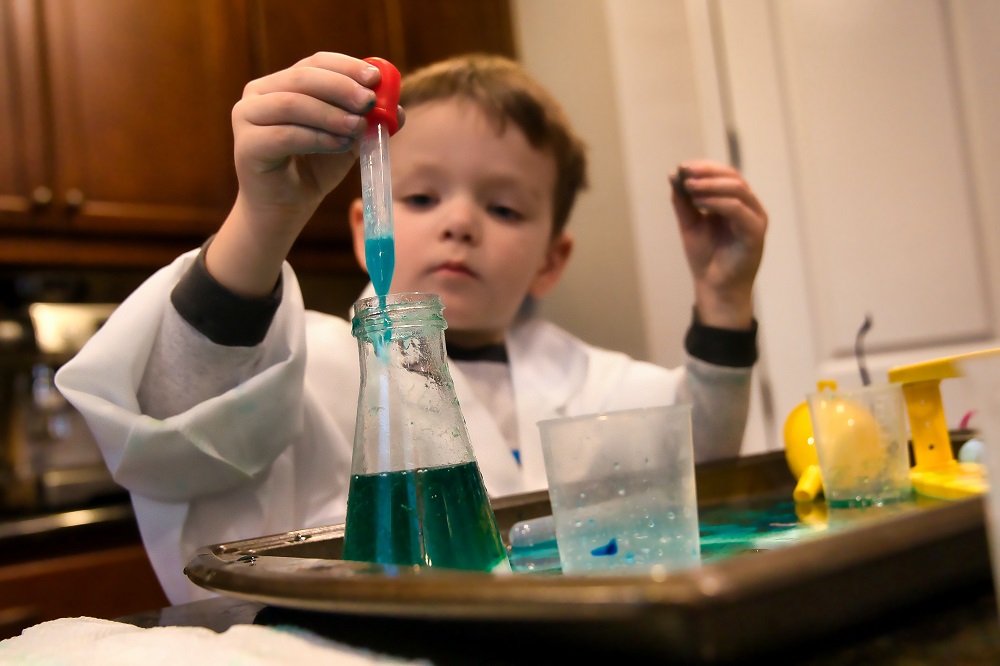
Take the monotony out of PSLE Science revision with this fun experiment you can do at home! Learn about how microorganisms function and reproduce by making a blow-up balloon using yeast. If you are looking for an interesting activity to enhance your understanding of the PSLE Science syllabus, why not give this home experiment a try?

Introduction

Yeasts are single-celled microorganisms classified under the fungus kingdom. We learn in primary Science that living organisms need air, food and water to survive. Just like people, yeast needs air and food, and it releases carbon dioxide as a waste product. Have you ever wondered why bread has holes in it? Most bread is baked using yeast, which is kneaded into the flour and starts making tiny gas bubbles. These gas bubbles are actually carbon dioxide as a waste product, and they look like little holes in bread dough. When the bread is baked in an oven, the yeast dies, leaving behind these pockets of air which are the holes we see in bread.

Through this experiment, you will carry out variable testing to observe how different temperature levels affect how quickly yeast grows. This will be demonstrated through the carbon dioxide produced by yeast, which can be used to inflate a balloon. Be sure to make a hypothesis before carrying out the experiment!

Materials Required

To run this experiment, you will need the following items:

  • Four packets of yeast (you should be able to find these at the supermarket)
  • Four empty plastic drink bottles
  • Four balloons, not inflated
  • Four teaspoons of sugar
  • 500 ml of chilled water
  • 500 ml of warm water
  • Four measuring cups (for measuring out the water)
  • A marker (for labelling your plastic bottles)
  • A stopwatch

Experiment Steps

First, divide the chilled water into each of the measuring cups as follows:

  • Cup 1: 50 ml
  • Cup 2: 100 ml
  • Cup 3: 150 ml
  • Cup 4: 200 ml

Next, pour enough warm water into cups 1, 2, and 3 so that the total amount of water in them reaches 200 ml. Once you have all four measuring cups of water ready, pour the contents of each cup into a different plastic drink bottle and label the bottles with the proportion of cold to warm water that you used for each one. Yeast is in an inactive state when it is cold and dry, which is why we need to put water in the bottles to activate the yeast.

Yeast also needs nutrition to grow, so we’ll be giving it sugar. Add one teaspoon of sugar to every bottle, and gently swirl the bottles a few times to dissolve the sugar.

You can now add the yeast to the bottles. Put one whole packet of yeast into every bottle. Make sure to have your balloons ready, because right after you add the yeast, you need to quickly stretch a balloon over the mouth of each bottle. The yeast will become active once it is in water, and we want to ensure that as little air as possible can escape once the yeast activates in order to obtain a more accurate result. Start the stopwatch when all bottles are covered with a balloon.

The yeast will have become active and started “eating” the sugar in each bottle. However, because yeast is a microorganism, they are too tiny to be seen unless they are put under a microscope. It may seem like nothing is happening for the first few minutes, but gradually, you should see the balloons start to expand and rise. This is happening because the yeast is giving out carbon dioxide, which fills the air in the bottle as well as the balloon. Which balloon do you think will rise first, and which will be the slowest?

Record the time on your stopwatch at which each balloon rises and stands up straight. Were the results the same as what you predicted? Why do you think the balloons rose at different times, and what did the water temperature of each bottle have to do with it?

After the experiment, try leaving the bottles alone for a couple of days to see what happens to the air in the balloons. Yeast has a short lifespan and the colony in each bottle will eventually die after some days. Do you think the air in the balloons will remain the same, increase, or decrease?

For an added bonus, try repeating this experiment with a new hypothesis – but this time, use different amounts of sugar for each bottle and keep the water temperatures the same. What can you tell about the effects of sugar and temperature on the growth of yeast? What do you think is an optimal condition for yeast to grow?

Now Your child can easily crack PSLE Science And JC Chemistry exams!

GCSE Chemistry study skills

Get the Best JC Chemistry and PSLE Science Tuition in Singapore Today

Importance of JC Chemistry

Chemistry is an essential and central part of science, bridges Physics, Biology, and Geology. It is a pre-requisite to some of the most sought-after university courses such as Medicine, Dentistry, Pharmacy, Chemical, environmental engineering, etc. The Junior College Chemistry is an intensive two-year pre-university course requiring students to have a solid and in-depth grasp of many Chemistry topics. The relevance of studying JC Chemistry is vast, particularly in this growing scientific world.Our JC Chemistry tuition lessons are designed to help your child achieve highly productive and effective learning.

Teachers and tutors are the frontlines in giving students the edge to succeed in their education.

The short runway to the national examinations is highly stressful for most Junior College students. Why worry? Your child will have the most holistic JC Chemistry tuition support here. To ease anxieties and fear about Junior College Chemistry, you can help your child by choosing well trained  Junior College Chemistry Tutor in Singapore!

We have the top Junior College Chemistry Tutors dedicated and well experienced who will teach students answering techniques using keywords for qualitative questions.

Our tutors will provide student learning materials with chemistry concepts while introducing mnemonics that help your child remember scientific formulas for better memory recall. In addition, our tutors devise faster problem-solving methods with reduced steps which helps students save time during exams. As a result, we have helped countless Junior College students ace their Chemistry examinations.

Our tuition on JC Chemistry comes in many different ways!

Our students will acquire the ability to deconstruct the mechanism and resolve chemistry questions. In addition, students can understand the vast scope of Organic Chemistry with the help of mind maps and tailored JC Chemistry tuition materials.

Acid-Base Equilibrium, Reaction Kinetics, Organic Chemistry are the most challenging topics in chemistry. Simply Chemistry dives deep into the mechanism and learns how to apply the thoroughly explained concepts in our JC Chemistry classes.

Students can be at ease with a tutor, knowing they will receive additional guidance curated towards their weaknesses. Finding the right teachers to guide your child is paramount to that success. So why are you still delaying to ease your child’s life? Enroll your child in our JC chemistry class to help them secure high academic scores in their chemistry subject.

Importance of PSLE Science

The Primary School Leaving Examination marks the end of a student’s 6-year journey in their Primary School. Students are tested on the content learned over the past years to advance to the next phase of their educational journey in Singapore. When it particularly comes to PSLE science, this subject is considered one of the most confusing topics for any young child. It’s a challenging subject that can be very hard to get right if you aren’t sure where to begin. However, this PSLE science is often a subject that takes your child to the next secondary school learning step.

You always look carefully everywhere to make the right choices for tuition!

There are lots of reasons why people invest in PSLE science. However, one of the most beneficial investments you can make when taking tuition classes is getting a PSLE science tutor, especially P6. The tutor offering PSLE science tuition must be one who can support and attain your child’s goals. Our highly trained teachers will give your child the knowledge and skills to achieve PSLE science with more marks.

Benefits that your child will get from us

  1. Your child will get a crystal clear understanding of the main Science concepts that will surely emerge during PSLE and help them gain confidence.
  2. Our experienced tutors will teach your child strategically, and they will teach about all the common mistakes that happen and measures to stop them, thereby increasing their overall score.
  3. The student will be trained under the able guidance of our learned and expert teachers.
  4. The students in our tuition will be prepared for all kinds of questions by practicing a vast range of questions with multiple answering techniques.

Our PSLE Science program will impart key strategies to meet the demands!

Our PSLE science tuition program will teach students the topics already studied from previous science classes. Our qualified tutor will explain complicated scientific concepts more easily and quickly, which is tough for your child to remember. We will continuously monitor your children’s performance. We will observe their strong and weak points and teach them according to that. We have highly dedicated teaching staff to help our students gain the best education and help them to gain more marks in their PSLE exams.

Is Your Child Procrastinating? Keep Them Productive With These Simple Tips!

clint patterson CgIFBwOkApI unsplash

We all have 24 hours in a day, but are we putting them to full use?

Although we may start the day with ambitious visions of what we could achieve, many of us are no stranger to ending the day with only a fraction of our goals completed. It is all too easy to get distracted along the way and lose track of time. It is even more crucial when your child is studying for their PSLE examinations to stay on task. The lengthy syllabus of Primary Science or Primary Maths requires a great deal of time and dedication if your child is to internalise every concept and prepare for the exams, especially within the tight timeframe they are afforded.

This may raise a pressing issue: if your child is prone to procrastination, what can you do to keep them productive? Well, here are some of our suggestions.

Remove All Distractions

Your child may enjoy studying in the comforts of their room, but are they studying efficiently? Some of the biggest culprits behind frequent procrastination could be that TV or video game in the corner. It is important to set some ground rules for studying hours, such as disallowing phones at the table. Find a quiet spot where your child can revise without distractions or interruptions. If the home environment is noisy, moving to a more conducive spot or location such as the library may be a good idea. Some students also like to stay back in school after their lessons to revise. It all depends on the ideal environment for your child to concentrate without turning their attention to other things.

Settle on a Schedule

Discipline is a key factor in avoiding procrastination. A student without a schedule is like a ship without a captain – planning each day’s revision topics beforehand is crucial in giving your child a clear direction to follow. Apart from preventing them from wasting more time on figuring out what to do next, a well-planned outline also helps your child visualise how much they need to get done for the day, enabling them to pace themselves accordingly. You can plan a schedule together with your child and decide what to focus on each day. For instance, perhaps you want to reserve Mondays and Wednesdays to revise Primary Maths, especially if it is your child’s weakest subject. Start with that and sketch up a plan detailing which topics should be revised on each day. Any plan is a great start – it is alright to change the plan later on if you or your child feels the need to.

Set Small, Realistic Milestones

Many people like to aim big, but in doing so, they are also setting themselves up for procrastination. It is usually much easier to focus on a job and get it done when you have the end in sight, rather than looking at a large pile of work to be done and feeling the inertia kick in.

If you are already setting goals for your child but they are having trouble accomplishing these milestones, it may be time to re-evaluate your plans. Perhaps you might need to set the bar a little lower so that it is in better reach for your child. For instance, if your child is struggling with finishing an entire test paper in one sitting, try breaking it into more manageable sections for a start. Have your child attempt Section A first and come back to the other sections later. As they get more comfortable with the questions, you can gradually add on the rest of the paper until they are able to complete everything without wearing out. At the end of the day, nothing beats the sense of accomplishment that you have knocked everything off the day’s to-do list.

Take Well-Deserved Breaks

Everyone has a limit, and it is important not to push your child too hard. It may seem counterintuitive to speed up revision progress by encouraging breaks, but a respite is sometimes necessary. Allow your child to take a breather if they have been going at a good pace. The prospect of a timely break can also help to spur a person on to complete their tasks more efficiently.

Revise With Your Child

It can be difficult to stay focused on one’s own. Tackling the revision together with your child can help them to keep on track. Not only will you be able to guide your child along the way, but it will also mean the world to them for their parents to take interest in and work together with them on their goals. You do not have to be an expert in a subject to tutor your child in it, the experience can even be better when you learn together.